Cardiovascular-Kidney-Metabolic (CKM) Syndrome
Cardiovascular-Kidney-Metabolic (CKM) Syndrome
Cardiovascular-Kidney-Metabolic (CKM) Syndrome
AI for Risk Prediction and Diet & Lifestyle Care in Cardiovascular-Kidney-Metabolic Syndrome
AI for Risk Prediction and Diet & Lifestyle Care in Cardiovascular-Kidney-Metabolic Syndrome
AI for Risk Prediction and Diet & Lifestyle Care in Cardiovascular-Kidney-Metabolic Syndrome

Overview
Overview
Overview
Cardiovascular-Kidney-Metabolic (CKM) syndrome describes how heart, kidney and metabolic health are linked: when one system weakens, it puts strain on the others. Obesity, diabetes, hypertension, chronic kidney disease and cardiovascular disease are better seen as one connected continuum than as separate conditions.
Cardiovascular-Kidney-Metabolic (CKM) syndrome describes how heart, kidney and metabolic health are linked: when one system weakens, it puts strain on the others. Obesity, diabetes, hypertension, chronic kidney disease and cardiovascular disease are better seen as one connected continuum than as separate conditions.
Cardiovascular-Kidney-Metabolic (CKM) syndrome describes how heart, kidney and metabolic health are linked: when one system weakens, it puts strain on the others. Obesity, diabetes, hypertension, chronic kidney disease and cardiovascular disease are better seen as one connected continuum than as separate conditions.


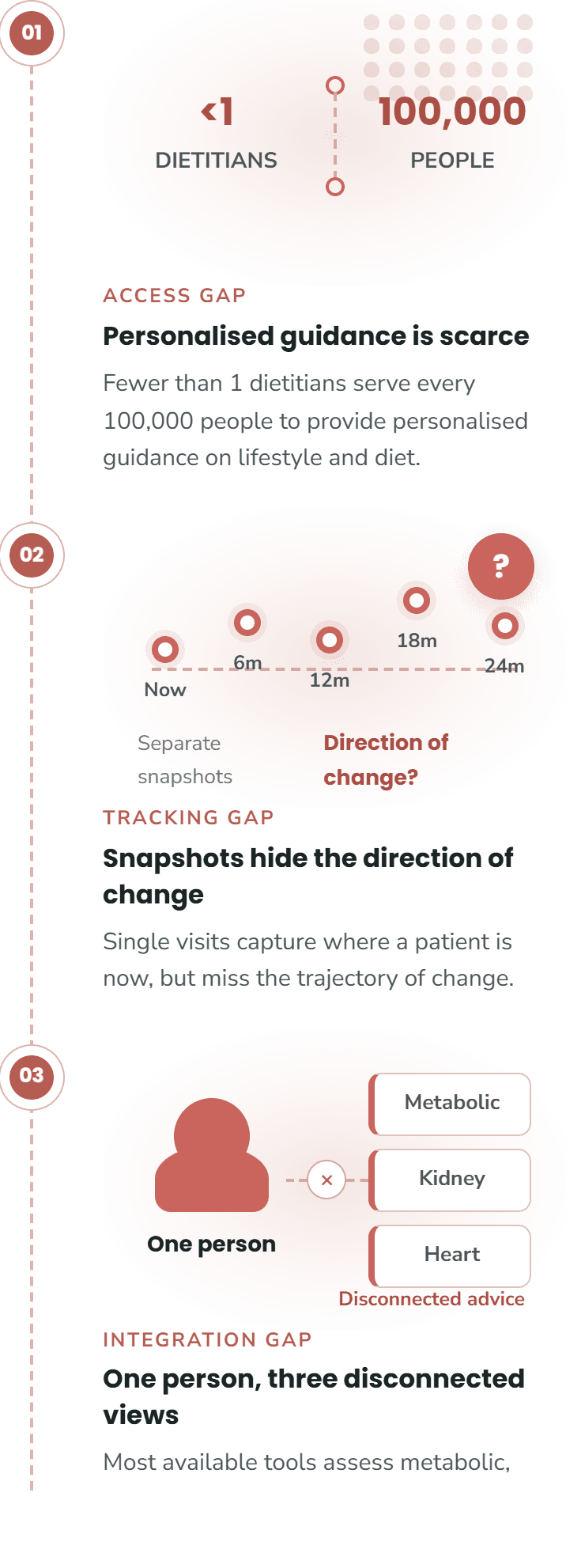
Good CKM care means assessing a person's current stage, setting personalised diet and lifestyle plans, supporting treatment and reviewing progress over time. Current care pathways make this hard to deliver.
Good CKM care means assessing a person's current stage, setting personalised diet and lifestyle plans, supporting treatment and reviewing progress over time. Current care pathways make this hard to deliver.
Good CKM care means assessing a person's current stage, setting personalised diet and lifestyle plans, supporting treatment and reviewing progress over time. Current care pathways make this hard to deliver.

Our Solution
Our Solution
Our Solution
To address this, TANUH is developing a multilingual, voice-first, human-in-the-loop AI tool. It helps non-physician health workers, general practitioners and clinicians read CKM information consistently. The tool combines diet, physiology, blood and urine biomarkers, and CKM-related medical history from repeated visits. A small language model (SLM) links these four inputs.
To address this, TANUH is developing a multilingual, voice-first, human-in-the-loop AI tool. It helps non-physician health workers, general practitioners and clinicians read CKM information consistently. The tool combines diet, physiology, blood and urine biomarkers, and CKM-related medical history from repeated visits. A small language model (SLM) links these four inputs.
To address this, TANUH is developing a multilingual, voice-first, human-in-the-loop AI tool. It helps non-physician health workers, general practitioners and clinicians read CKM information consistently. The tool combines diet, physiology, blood and urine biomarkers, and CKM-related medical history from repeated visits. A small language model (SLM) links these four inputs.


Solution 1
Solution 1
Solution 1
An AI-based longitudinal risk deviance score prediction model that projects how a person's CKM health will change.
An AI-based longitudinal risk deviance score prediction model that projects how a person's CKM health will change.
An AI-based longitudinal risk deviance score prediction model that projects how a person's CKM health will change.
Goals
Goals
Goals
Spot people whose CKM health is getting worse before they move to a higher stage
Show the direction of change, not just a one-time snapshot
Give care teams one integrated view of heart, kidney and metabolic risk
Spot people whose CKM health is getting worse before they move to a higher stage
Show the direction of change, not just a one-time snapshot
Give care teams one integrated view of heart, kidney and metabolic risk
Spot people whose CKM health is getting worse before they move to a higher stage
Show the direction of change, not just a one-time snapshot
Give care teams one integrated view of heart, kidney and metabolic risk
Key Features of the Solution:
Key Features of the Solution:
Key Features of the Solution:
Combines four inputs: diet, physiology, biomarkers and CKM syndrome data
Models change across repeated visits
Predicts risk trajectory at 6 months and 1 year
Combines four inputs: diet, physiology, biomarkers and CKM syndrome data
Models change across repeated visits
Predicts risk trajectory at 6 months and 1 year
Combines four inputs: diet, physiology, biomarkers and CKM syndrome data
Models change across repeated visits
Predicts risk trajectory at 6 months and 1 year
Solution 2
Solution 2
Solution 2
An AI-based diet and lifestyle recommendation system that prepares personalised priorities for clinical review.
An AI-based diet and lifestyle recommendation system that prepares personalised priorities for clinical review.
An AI-based diet and lifestyle recommendation system that prepares personalised priorities for clinical review.
Goals
Goals
Goals
Make personalised diet guidance available where dietitians are scarce
Give recommendations that are culturally and regionally relevant
Help people stay stable or move back to an earlier stage
Make personalised diet guidance available where dietitians are scarce
Give recommendations that are culturally and regionally relevant
Help people stay stable or move back to an earlier stage
Make personalised diet guidance available where dietitians are scarce
Give recommendations that are culturally and regionally relevant
Help people stay stable or move back to an earlier stage
Key Features of the Solution:
Key Features of the Solution:
Key Features of the Solution:
Food-pattern recommendations with regional alternatives and practical next steps
Multilingual and voice-first, so frontline workers can use it
Human review at every clinical cycle: clinical nutritionists review Stages 0–2 and expert clinicians review Stages 3–4 before anything is shared
Supports clinical judgement rather than replacing it, and never recommends changes to prescribed medication
Team & Collaborators
Team & Collaborators
Team & Collaborators
Principal Investigator
Principal Investigator
Principal Investigator

Sriram Ganapathy
Sriram Ganapathy
Sriram Ganapathy
Associate Professor
Department of Electrical Engineering, IISc
Associate Professor
Department of Electrical Engineering, IISc
Associate Professor
Department of Electrical Engineering, IISc
Co-Principal Investigator
Co-Principal Investigator
Co-Principal Investigator

Lakshmi Krishnan
Lakshmi Krishnan
Lakshmi Krishnan
Sr. Program Manager
TANUH
Sr. Program Manager
TANUH
Sr. Program Manager
TANUH

Prabhdeep Kaur
Prabhdeep Kaur
Prabhdeep Kaur
Chair and Professor
Isaac Centre for Public Health, IISc
Personal website
Chair and Professor
Isaac Centre for Public Health, IISc
Personal website
Chair and Professor
Isaac Centre for Public Health, IISc
Personal website

Sundar Swaminathan
Sundar Swaminathan
Sundar Swaminathan
Endowed Chair Professor & Head
Department of Nephrology,
Tata-IISc Medical School
Personal website
Endowed Chair Professor & Head
Department of Nephrology,
Tata-IISc Medical School
Personal website
Endowed Chair Professor & Head
Department of Nephrology,
Tata-IISc Medical School
Personal website
Team
Team
Team

Arjun Anand
Arjun Anand
Arjun Anand
Technical Staff
Technical Staff
Technical Staff

Ramoju Raghavamsi
Ramoju Raghavamsi
Ramoju Raghavamsi
ML Intern
ML Intern
ML Intern

Sonie Sait
Sonie Sait
Sonie Sait
Clinical Coordinator
Clinical Coordinator
Clinical Coordinator
Partners & Collaborators
Partners & Collaborators
Partners & Collaborators




Get Involved
Get Involved
Get Involved
We invite collaborations with cardiologists, nephrologists, endocrinologists and clinical nutritionists; AI researchers and data scientists; public health organisations; hospitals and healthcare institutions; and technology partners.
We invite collaborations with cardiologists, nephrologists, endocrinologists and clinical nutritionists; AI researchers and data scientists; public health organisations; hospitals and healthcare institutions; and technology partners.
We invite collaborations with cardiologists, nephrologists, endocrinologists and clinical nutritionists; AI researchers and data scientists; public health organisations; hospitals and healthcare institutions; and technology partners.
Contact us at ckmsyndrome@tanuh.ai
Contact us at ckmsyndrome@tanuh.ai
Contact us at ckmsyndrome@tanuh.ai
The AI Centre of Excellence in Healthcare

AI Centre of Excellence in Healthcare
Indian Institute of Science
Seventh Floor, TCS Smart-X Hub
Bengaluru, India - 560 012
Email: info@tanuh.ai
Telephone: (080) 2293 4106 | (080) 2293 4107
2026 by TANUH
The AI Centre of Excellence in Healthcare
AI Centre of Excellence in Healthcare
Indian Institute of Science
Seventh Floor, TCS Smart-X Hub
Bengaluru, India - 560 012
Email: info@tanuh.ai
Telephone: (080) 2293 4106 | (080) 2293 4107
2026 by TANUH
The AI Centre of Excellence in Healthcare
AI Centre of Excellence in Healthcare
Indian Institute of Science
Seventh Floor, TCS Smart-X Hub
Bengaluru, India - 560 012
Email: info@tanuh.ai
Telephone: (080) 2293 4106 | (080) 2293 4107
2026 by TANUH