Institutional Ethics Committee
Institutional Ethics Committee
Institutional Ethics Committee

Terms of Reference of the IEC
Terms of Reference of the IEC
Terms of Reference of the IEC
The Institutional Ethics Committee (IEC) will review and approve all research protocols involving human participants, with a primary focus on safeguarding the dignity, rights, safety, and wellbeing of all actual and potential participants. Regardless of the significance of the research objectives, these goals must never take precedence over the health and welfare of research participants. The IEC will ensure that the fundamental principles of research ethics, Autonomy, Beneficence, Non-malfeasance, and Justice, are rigorously upheld in the design, conduct, and reporting of all proposed studies. The IEC promotes good clinical practices (GCP) in all the studies approved by the committee.
In research involving AI tools, algorithms, or data-driven methodologies, the IEC will additionally evaluate ethical safeguards specific to AI, including transparency, data privacy, algorithmic fairness, explainability, and mitigation of potential biases or harms. The committee will carefully review the informed consent process, risk–benefit assessments, equitable distribution of burdens and benefits, and provisions for appropriate compensation where required.
Any protocol submitted to the IEC must have to undergo mandatory prior review and clearance by both the Scientific Review Board (SRB) and the Data Protection Compliance Committee (DPCC) to ensure that the proposed work is scientifically robust, clinically relevant, fully compliant with data privacy regulations, and strategically aligned with TANUH objectives and public health needs. The IEC will conduct oversight from the initial proposal stage through the entire lifecycle of the study, including post-completion monitoring, using well-documented procedures such as annual and final reports, and site visits. Compliance with all regulatory requirements, data protection mandates, applicable guidelines, and relevant laws including those pertaining to AI research will be examined. The IEC’s mandate encompasses the review of all research projects involving human subjects, including studies using human biological materials, health data, and personal information, conducted at TANUH, irrespective of the source of funding.
Registration with Department of Health Research (DHR)
Registration body: Department of Health Research (DHR), Ministry of Health & Family Welfare
Registration status: Registered
Effective date: 21-Jul-2026
Registration number: EC/NEW/INST/2025/5646
Governing rules: Chapter IV of the New Drugs and Clinical Trials Rules, 2019
Scope of authorization: The TANUH IEC is authorized to perform all duties of an ethics committee as specified under Chapter IV, including ethical review and oversight of clinical trials of new drugs and related research.
Registration with Central Drugs Standard Control Organisation (CDSCO)
Registration body: Central Drugs Standard Control Organisation (CDSCO), Ministry of Health & Family Welfare (acting as Central Licensing Authority)
Registration status: Registered
Effective date: 11-Aug-2026
Registration number: ECR/2273/Inst/KA/2026
Governing rules: Chapter III of the New Drugs and Clinical Trials Rules, 2019
Scope of authorization: The TANUH IEC is authorized to perform all duties of an ethics committee as specified under Chapter III, covering ethical review and oversight of clinical trials and studies regulated by CDSCO.
TANUH IEC operations are entirely paperless. Protocol submissions, Scientific Review Board and Data Protection Compliance Committee evaluations, IEC review and deliberation, approvals, and all correspondence with applicants are conducted through secure digital channels, from initial filing through post-approval monitoring and annual reporting. This digital-first workflow enables faster turnaround on applications, maintains a complete and traceable audit trail for every protocol, and strengthens data security in line with the Digital Personal Data Protection (DPDP) Act, while giving investigators real-time visibility into their submission status without any dependence on physical documentation.
The Institutional Ethics Committee (IEC) will review and approve all research protocols involving human participants, with a primary focus on safeguarding the dignity, rights, safety, and wellbeing of all actual and potential participants. Regardless of the significance of the research objectives, these goals must never take precedence over the health and welfare of research participants. The IEC will ensure that the fundamental principles of research ethics, Autonomy, Beneficence, Non-malfeasance, and Justice, are rigorously upheld in the design, conduct, and reporting of all proposed studies. The IEC promotes good clinical practices (GCP) in all the studies approved by the committee.
In research involving AI tools, algorithms, or data-driven methodologies, the IEC will additionally evaluate ethical safeguards specific to AI, including transparency, data privacy, algorithmic fairness, explainability, and mitigation of potential biases or harms. The committee will carefully review the informed consent process, risk–benefit assessments, equitable distribution of burdens and benefits, and provisions for appropriate compensation where required.
Any protocol submitted to the IEC must have to undergo mandatory prior review and clearance by both the Scientific Review Board (SRB) and the Data Protection Compliance Committee (DPCC) to ensure that the proposed work is scientifically robust, clinically relevant, fully compliant with data privacy regulations, and strategically aligned with TANUH objectives and public health needs. The IEC will conduct oversight from the initial proposal stage through the entire lifecycle of the study, including post-completion monitoring, using well-documented procedures such as annual and final reports, and site visits. Compliance with all regulatory requirements, data protection mandates, applicable guidelines, and relevant laws including those pertaining to AI research will be examined. The IEC’s mandate encompasses the review of all research projects involving human subjects, including studies using human biological materials, health data, and personal information, conducted at TANUH, irrespective of the source of funding.
Registration with Department of Health Research (DHR)
Registration body: Department of Health Research (DHR), Ministry of Health & Family Welfare
Registration status: Registered
Effective date: 21-Jul-2026
Registration number: EC/NEW/INST/2025/5646
Governing rules: Chapter IV of the New Drugs and Clinical Trials Rules, 2019
Scope of authorization: The TANUH IEC is authorized to perform all duties of an ethics committee as specified under Chapter IV, including ethical review and oversight of clinical trials of new drugs and related research.
Registration with Central Drugs Standard Control Organisation (CDSCO)
Registration body: Central Drugs Standard Control Organisation (CDSCO), Ministry of Health & Family Welfare (acting as Central Licensing Authority)
Registration status: Registered
Effective date: 11-Aug-2026
Registration number: ECR/2273/Inst/KA/2026
Governing rules: Chapter III of the New Drugs and Clinical Trials Rules, 2019
Scope of authorization: The TANUH IEC is authorized to perform all duties of an ethics committee as specified under Chapter III, covering ethical review and oversight of clinical trials and studies regulated by CDSCO.
TANUH IEC operations are entirely paperless. Protocol submissions, Scientific Review Board and Data Protection Compliance Committee evaluations, IEC review and deliberation, approvals, and all correspondence with applicants are conducted through secure digital channels, from initial filing through post-approval monitoring and annual reporting. This digital-first workflow enables faster turnaround on applications, maintains a complete and traceable audit trail for every protocol, and strengthens data security in line with the Digital Personal Data Protection (DPDP) Act, while giving investigators real-time visibility into their submission status without any dependence on physical documentation.
The Institutional Ethics Committee (IEC) will review and approve all research protocols involving human participants, with a primary focus on safeguarding the dignity, rights, safety, and wellbeing of all actual and potential participants. Regardless of the significance of the research objectives, these goals must never take precedence over the health and welfare of research participants. The IEC will ensure that the fundamental principles of research ethics, Autonomy, Beneficence, Non-malfeasance, and Justice, are rigorously upheld in the design, conduct, and reporting of all proposed studies. The IEC promotes good clinical practices (GCP) in all the studies approved by the committee.
In research involving AI tools, algorithms, or data-driven methodologies, the IEC will additionally evaluate ethical safeguards specific to AI, including transparency, data privacy, algorithmic fairness, explainability, and mitigation of potential biases or harms. The committee will carefully review the informed consent process, risk–benefit assessments, equitable distribution of burdens and benefits, and provisions for appropriate compensation where required.
Any protocol submitted to the IEC must have to undergo mandatory prior review and clearance by both the Scientific Review Board (SRB) and the Data Protection Compliance Committee (DPCC) to ensure that the proposed work is scientifically robust, clinically relevant, fully compliant with data privacy regulations, and strategically aligned with TANUH objectives and public health needs. The IEC will conduct oversight from the initial proposal stage through the entire lifecycle of the study, including post-completion monitoring, using well-documented procedures such as annual and final reports, and site visits. Compliance with all regulatory requirements, data protection mandates, applicable guidelines, and relevant laws including those pertaining to AI research will be examined. The IEC’s mandate encompasses the review of all research projects involving human subjects, including studies using human biological materials, health data, and personal information, conducted at TANUH, irrespective of the source of funding.
Registration with Department of Health Research (DHR)
Registration body: Department of Health Research (DHR), Ministry of Health & Family Welfare
Registration status: Registered
Effective date: 21-Jul-2026
Registration number: EC/NEW/INST/2025/5646
Governing rules: Chapter IV of the New Drugs and Clinical Trials Rules, 2019
Scope of authorization: The TANUH IEC is authorized to perform all duties of an ethics committee as specified under Chapter IV, including ethical review and oversight of clinical trials of new drugs and related research.
Registration with Central Drugs Standard Control Organisation (CDSCO)
Registration body: Central Drugs Standard Control Organisation (CDSCO), Ministry of Health & Family Welfare (acting as Central Licensing Authority)
Registration status: Registered
Effective date: 11-Aug-2026
Registration number: ECR/2273/Inst/KA/2026
Governing rules: Chapter III of the New Drugs and Clinical Trials Rules, 2019
Scope of authorization: The TANUH IEC is authorized to perform all duties of an ethics committee as specified under Chapter III, covering ethical review and oversight of clinical trials and studies regulated by CDSCO.
TANUH IEC operations are entirely paperless. Protocol submissions, Scientific Review Board and Data Protection Compliance Committee evaluations, IEC review and deliberation, approvals, and all correspondence with applicants are conducted through secure digital channels, from initial filing through post-approval monitoring and annual reporting. This digital-first workflow enables faster turnaround on applications, maintains a complete and traceable audit trail for every protocol, and strengthens data security in line with the Digital Personal Data Protection (DPDP) Act, while giving investigators real-time visibility into their submission status without any dependence on physical documentation.
Composition of TANUH-IEC
Composition of TANUH-IEC
Composition of TANUH-IEC

Dr. Shivaram Varambally MBBS, M.D (Psychiatry)
Dr. Shivaram Varambally MBBS, M.D (Psychiatry)
Dr. Shivaram Varambally MBBS, M.D (Psychiatry)
Chairperson
Chairperson
Chairperson
Professor of Psychiatry
National Institute of Mental Health and Neurosciences Hosur Road, Bengaluru, India
Professor of Psychiatry
National Institute of Mental Health and Neurosciences Hosur Road, Bengaluru, India
Professor of Psychiatry
National Institute of Mental Health and Neurosciences Hosur Road, Bengaluru, India

Dr. Virupaksha Harave MBBS, M.D (Psychiatry)
Dr. Virupaksha Harave MBBS, M.D (Psychiatry)
Dr. Virupaksha Harave MBBS, M.D (Psychiatry)
Clinician
Clinician
Clinician
Professor and Head, Department of Psychiatry
BGS Medical College Hospital Nagarur, Bengaluru
Professor and Head, Department of Psychiatry
BGS Medical College Hospital Nagarur, Bengaluru
Professor and Head, Department of Psychiatry
BGS Medical College Hospital Nagarur, Bengaluru

Dr. Ashwini Shetty. MBBS, MD (Dermatology)
Dr. Ashwini Shetty. MBBS, MD (Dermatology)
Dr. Ashwini Shetty. MBBS, MD (Dermatology)
Basic Medical Scientist
Basic Medical Scientist
Basic Medical Scientist
Consultant Dermatologist,
Apollo Hospital, Bannerghatta Road,
Bengaluru
Consultant Dermatologist,
Apollo Hospital, Bannerghatta Road,
Bengaluru
Consultant Dermatologist,
Apollo Hospital, Bannerghatta Road,
Bengaluru

Dr. Bhuvana K.B. MBBS, MD, DNB (Pharmacology)
Dr. Bhuvana K.B. MBBS, MD, DNB (Pharmacology)
Dr. Bhuvana K.B. MBBS, MD, DNB (Pharmacology)
Basic Medical Scientist
Basic Medical Scientist
Basic Medical Scientist
Associate Professor, Dept of Pharmacology,
St. John’s Medical College and Hospital, Bengaluru
Associate Professor, Dept of Pharmacology,
St. John’s Medical College and Hospital, Bengaluru
Associate Professor, Dept of Pharmacology,
St. John’s Medical College and Hospital, Bengaluru

Dr. Anish V Cherian M.S.W, PhD (Psychiatric Social Work)
Dr. Anish V Cherian M.S.W, PhD (Psychiatric Social Work)
Dr. Anish V Cherian M.S.W, PhD (Psychiatric Social Work)
Social Scientist
Social Scientist
Social Scientist
Additional Professor of Psychiatric Social Work
National Institute of Mental Health and Neuro Sciences (NIMHANS),
Bengaluru, India
Additional Professor of Psychiatric Social Work
National Institute of Mental Health and Neuro Sciences (NIMHANS),
Bengaluru, India
Additional Professor of Psychiatric Social Work
National Institute of Mental Health and Neuro Sciences (NIMHANS),
Bengaluru, India

Dr. Arpitha Jacob M.Phil, PhD (Clinical Psychology)
Dr. Arpitha Jacob M.Phil, PhD (Clinical Psychology)
Dr. Arpitha Jacob M.Phil, PhD (Clinical Psychology)
Social Scientist
Social Scientist
Social Scientist
Assistant Professor, Dept of Liberal Arts, Humanities and Social Sciences
Manipal Academy of Higher Education (MAHE),
Bengaluru, India
Assistant Professor, Dept of Liberal Arts, Humanities and Social Sciences
Manipal Academy of Higher Education (MAHE),
Bengaluru, India
Assistant Professor, Dept of Liberal Arts, Humanities and Social Sciences
Manipal Academy of Higher Education (MAHE),
Bengaluru, India

Sri. Aswatha Narayana B.Sc., LL.M (Business Law)
Sri. Aswatha Narayana B.Sc., LL.M (Business Law)
Sri. Aswatha Narayana B.Sc., LL.M (Business Law)
Legal expert
Legal expert
Legal expert
District & Session Judge (R)
Former Chairman of Permanent Lok Adalath
Poorna Pragna Nagara, Bengaluru
District & Session Judge (R)
Former Chairman of Permanent Lok Adalath
Poorna Pragna Nagara, Bengaluru
District & Session Judge (R)
Former Chairman of Permanent Lok Adalath
Poorna Pragna Nagara, Bengaluru

Mr. Swapnesh Banerjee M.E (Electrical Engineering)
Mr. Swapnesh Banerjee M.E (Electrical Engineering)
Mr. Swapnesh Banerjee M.E (Electrical Engineering)
Lay person
Lay person
Lay person
Senior Technologist
Senior Technologist
Senior Technologist

Prof. Vaanathi Sundaresan B.Tech, PhD (Medical Imaging)
Prof. Vaanathi Sundaresan B.Tech, PhD (Medical Imaging)
Prof. Vaanathi Sundaresan B.Tech, PhD (Medical Imaging)
Affiliated Scientific Member
Affiliated Scientific Member
Affiliated Scientific Member
Assistant Professor, Department of Computational and Data Sciences, IISc
Assistant Professor, Department of Computational and Data Sciences, IISc
Assistant Professor, Department of Computational and Data Sciences, IISc

Dr. Prasad Sudhakar B.E, PhD (Applied Mathematics)
Dr. Prasad Sudhakar B.E, PhD (Applied Mathematics)
Dr. Prasad Sudhakar B.E, PhD (Applied Mathematics)
Affiliated Scientific Member
Affiliated Scientific Member
Affiliated Scientific Member
Chief AI Scientist,
TANUH
Chief AI Scientist,
TANUH
Chief AI Scientist,
TANUH

Dr. Sri Vidhya Jagadish MBBS
Dr. Sri Vidhya Jagadish MBBS
Dr. Sri Vidhya Jagadish MBBS
Member Secretary
Member Secretary
Member Secretary
Ethics Committee Operations Manager,
TANUH
Email ID: secretary.iec@tanuh.ai
Ethics Committee Operations Manager,
TANUH
Email ID: secretary.iec@tanuh.ai
Ethics Committee Operations Manager,
TANUH
Email ID: secretary.iec@tanuh.ai

Mr. Swapnesh Banerjee
Mr. Swapnesh Banerjee
Mr. Swapnesh Banerjee
Senior Technologist
Senior Technologist
Senior Technologist
Standard Operating Procedure (SOP)
Standard Operating Procedure (SOP)
Standard Operating Procedure (SOP)
A minimum of 3 days for the Scientific Committee to review the proposals and a minimum of 1 week for Ethics Committee members to review the applications. This would mean that applications need to be filed 2 weeks before an IEC meeting.
A minimum of 3 days for the Scientific Committee to review the proposals and a minimum of 1 week for Ethics Committee members to review the applications. This would mean that applications need to be filed 2 weeks before an IEC meeting.
A minimum of 3 days for the Scientific Committee to review the proposals and a minimum of 1 week for Ethics Committee members to review the applications. This would mean that applications need to be filed 2 weeks before an IEC meeting.
Review pathway: Scientific Review Board (SRB) and Data Protection Compliance Committee (DPCC) → Institutional Ethics Committee (IEC) final approval
Review pathway: Scientific Review Board (SRB) and Data Protection Compliance Committee (DPCC) → Institutional Ethics Committee (IEC) final approval
Review pathway: Scientific Review Board (SRB) and Data Protection Compliance Committee (DPCC) → Institutional Ethics Committee (IEC) final approval
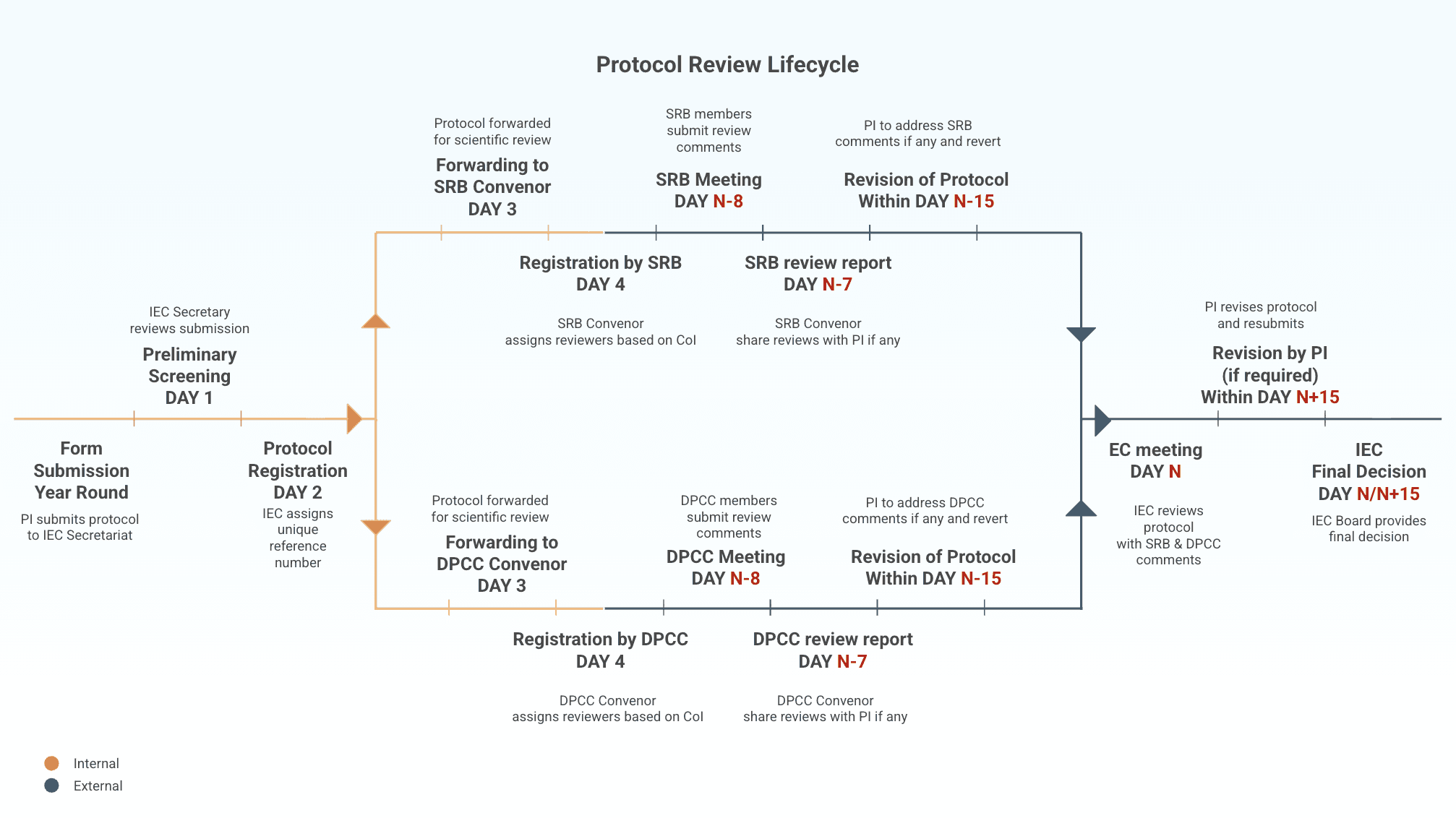
Scientific Review Board (SRB)
Scientific Review Board (SRB)
Scientific Review Board (SRB)
The Scientific Review Board (SRB) shall consist of domain experts with experience in the scientific, technical, and methodological evaluation of the proposals. The SRB ensures that all projects meet standards of scientific validity and methodological soundness before submission to the IEC.
The Scientific Review Board (SRB) shall consist of domain experts with experience in the scientific, technical, and methodological evaluation of the proposals. The SRB ensures that all projects meet standards of scientific validity and methodological soundness before submission to the IEC.
The Scientific Review Board (SRB) shall consist of domain experts with experience in the scientific, technical, and methodological evaluation of the proposals. The SRB ensures that all projects meet standards of scientific validity and methodological soundness before submission to the IEC.
Members
Members
Members

Chief Engineering Manager, TANUH
Chief Engineering Manager, TANUH
Chief Engineering Manager, TANUH

Program Manager, Breast Cancer, TANUH
Program Manager, Breast Cancer, TANUH
Program Manager, Breast Cancer, TANUH

Chief Project Manager, TANUH
Chief Project Manager, TANUH
Chief Project Manager, TANUH
Assistant Professor, Department of Computational and Data Sciences, IISc
Assistant Professor, Department of Computational and Data Sciences, IISc
Assistant Professor, Department of Computational and Data Sciences, IISc
Vascular Disease Screening Lead, TANUH,
Assistant Professor, Department of Bioengineering, IISc
Vascular Disease Screening Lead, TANUH,
Assistant Professor, Department of Bioengineering, IISc
Vascular Disease Screening Lead, TANUH,
Assistant Professor, Department of Bioengineering, IISc
Chief AI Scientist,
TANUH
Chief AI Scientist,
TANUH
Chief AI Scientist,
TANUH

Ethics Team Coordinator,
Data Protection Officer (DPO),
Public Health Specialist
Ethics Team Coordinator,
Data Protection Officer (DPO),
Public Health Specialist
Ethics Team Coordinator,
Data Protection Officer (DPO),
Public Health Specialist
Prof. Vaanathi Sundaresan
Prof. Vaanathi Sundaresan
Prof. Vaanathi Sundaresan
Assistant Professor, Department of Computational and Data Sciences, IISc
Assistant Professor, Department of Computational and Data Sciences, IISc
Assistant Professor, Department of Computational and Data Sciences, IISc
Bhaskara Rao Chintada
Bhaskara Rao Chintada
Bhaskara Rao Chintada
Vascular Disease Screening Lead, TANUH,
Assistant Professor, Department of Bioengineering, IISc
Vascular Disease Screening Lead, TANUH,
Assistant Professor, Department of Bioengineering, IISc
Vascular Disease Screening Lead, TANUH,
Assistant Professor, Department of Bioengineering, IISc
Data Protection Compliance Committee (DPCC)
Data Protection Compliance Committee (DPCC)
Data Protection Compliance Committee (DPCC)
To ensure the highest standards of privacy and ethical integrity in AI healthcare research, the Data Protection Compliance Committee (DPCC) serves as the primary oversight body for the TANUH: AI Centre of Excellence in Healthcare.
The DPCC ensures that every project involving sensitive health information remains compliant with the Digital Personal Data Protection (DPDP) Act and National Ethical Guidelines.
To ensure the highest standards of privacy and ethical integrity in AI healthcare research, the Data Protection Compliance Committee (DPCC) serves as the primary oversight body for the TANUH: AI Centre of Excellence in Healthcare.
The DPCC ensures that every project involving sensitive health information remains compliant with the Digital Personal Data Protection (DPDP) Act and National Ethical Guidelines.
To ensure the highest standards of privacy and ethical integrity in AI healthcare research, the Data Protection Compliance Committee (DPCC) serves as the primary oversight body for the TANUH: AI Centre of Excellence in Healthcare.
The DPCC ensures that every project involving sensitive health information remains compliant with the Digital Personal Data Protection (DPDP) Act and National Ethical Guidelines.
Core Mandate & Responsibilities
Core Mandate & Responsibilities
Core Mandate & Responsibilities
Protocol Oversight: Reviewing and approving all data collection and curation of protocols for TANUH projects to ensure scientific and ethical rigor.
Regulatory Compliance: Guaranteeing that all data handling, storage, and sharing practices strictly adhere to the DPDP Act and prevailing healthcare privacy norms.
Technical Advisory: Acting as a specialized consultant to the IEC on complex technical matters, including data pseudonymization, de-identification, and cybersecurity.
Lifecycle Monitoring: Continuously auditing data integrity and safety throughout the entire research and development lifecycle, from initial acquisition to final model deployment/continuous fine tuning.
Protocol Oversight: Reviewing and approving all data collection and curation of protocols for TANUH projects to ensure scientific and ethical rigor.
Regulatory Compliance: Guaranteeing that all data handling, storage, and sharing practices strictly adhere to the DPDP Act and prevailing healthcare privacy norms.
Technical Advisory: Acting as a specialized consultant to the IEC on complex technical matters, including data pseudonymization, de-identification, and cybersecurity.
Lifecycle Monitoring: Continuously auditing data integrity and safety throughout the entire research and development lifecycle, from initial acquisition to final model deployment/continuous fine tuning.
Protocol Oversight: Reviewing and approving all data collection and curation of protocols for TANUH projects to ensure scientific and ethical rigor.
Regulatory Compliance: Guaranteeing that all data handling, storage, and sharing practices strictly adhere to the DPDP Act and prevailing healthcare privacy norms.
Technical Advisory: Acting as a specialized consultant to the IEC on complex technical matters, including data pseudonymization, de-identification, and cybersecurity.
Lifecycle Monitoring: Continuously auditing data integrity and safety throughout the entire research and development lifecycle, from initial acquisition to final model deployment/continuous fine tuning.
Detailed overview of DPCC responsibilities:
Detailed overview of DPCC responsibilities:
Detailed overview of DPCC responsibilities:
Reviewing study protocols from a data security and privacy perspective, including data collection, storage, access control, and processing workflows.
Being formally notified in the event of any personal data breach or data leak during the course of the study.
Overseeing compliance with the DPDP Act requirement that participants are notified within 72 hours of a confirmed data breach.
Leading and guiding the formulation of policies and standard operating procedures (SOPs) related to data breach management, escalation pathways, participant notification, and documentation.
Providing ongoing oversight and recommendations to strengthen data protection and risk mitigation throughout the study lifecycle.
Reviewing study protocols from a data security and privacy perspective, including data collection, storage, access control, and processing workflows.
Being formally notified in the event of any personal data breach or data leak during the course of the study.
Overseeing compliance with the DPDP Act requirement that participants are notified within 72 hours of a confirmed data breach.
Leading and guiding the formulation of policies and standard operating procedures (SOPs) related to data breach management, escalation pathways, participant notification, and documentation.
Providing ongoing oversight and recommendations to strengthen data protection and risk mitigation throughout the study lifecycle.
Reviewing study protocols from a data security and privacy perspective, including data collection, storage, access control, and processing workflows.
Being formally notified in the event of any personal data breach or data leak during the course of the study.
Overseeing compliance with the DPDP Act requirement that participants are notified within 72 hours of a confirmed data breach.
Leading and guiding the formulation of policies and standard operating procedures (SOPs) related to data breach management, escalation pathways, participant notification, and documentation.
Providing ongoing oversight and recommendations to strengthen data protection and risk mitigation throughout the study lifecycle.
Integration with IEC Approval
Integration with IEC Approval
Integration with IEC Approval
Mandatory Requirement: In line with our commitment to data security, DPCC clearance is a mandatory prerequisite. No project involving human subject data may receive final IEC approval without prior authorization from the DPCC.
Mandatory Requirement: In line with our commitment to data security, DPCC clearance is a mandatory prerequisite. No project involving human subject data may receive final IEC approval without prior authorization from the DPCC.
Mandatory Requirement: In line with our commitment to data security, DPCC clearance is a mandatory prerequisite. No project involving human subject data may receive final IEC approval without prior authorization from the DPCC.
Members
Members
Members

Chair
Chair
Chair
External of TANUH
Head of Data Science, Eka Care
External of TANUH
Head of Data Science, Eka Care
External of TANUH
Head of Data Science, Eka Care
Chief Project Manager, TANUH
Chief Project Manager, TANUH
Chief Project Manager, TANUH
Technical/Imaging
Technical/Imaging
Technical/Imaging
Assistant Professor, Department of Computational and Data Sciences, IISc
Assistant Professor, Department of Computational and Data Sciences, IISc
Assistant Professor, Department of Computational and Data Sciences, IISc

Ethics/Regulatory
Ethics/Regulatory
Ethics/Regulatory
Member Secretary, TANUH IEC
Member Secretary, TANUH IEC
Member Secretary, TANUH IEC

Engineering/Implementation
Engineering/Implementation
Engineering/Implementation
Lead Architect, TANUH
Lead Architect, TANUH
Lead Architect, TANUH
Chief AI Scientist,
TANUH
Chief AI Scientist,
TANUH
Chief AI Scientist,
TANUH
Data Protection Officer
Data Protection Officer
Data Protection Officer
Mr. Shailesh Albuquerque
Mr. Shailesh Albuquerque
Mr. Shailesh Albuquerque
Engineering/Implementation
Engineering/Implementation
Engineering/Implementation
Lead Architect, TANUH
Lead Architect, TANUH
Lead Architect, TANUH
Dr. Prasad Sudhakar
Dr. Prasad Sudhakar
Dr. Prasad Sudhakar
Chief AI Scientist,
TANUH
Chief AI Scientist,
TANUH
Chief AI Scientist,
TANUH
IEC Approved Protocols
IEC Approved Protocols
IEC Approved Protocols
Protocol Title
Protocol Title
Protocol Title
Date of Ethics Committee Approval
Date of Ethics Committee Approval
Date of Ethics Committee Approval
CTRI Number
CTRI Number
CTRI Number
Date of CTRI Approval
Date of CTRI Approval
Date of CTRI Approval
Personalised AI-Enabled Risk Prediction and Diet and Lifestyle Management for Cardiovascular-Kidney-Metabolic (CKM) Syndrome.
Personalised AI-Enabled Risk Prediction and Diet and Lifestyle Management for Cardiovascular-Kidney-Metabolic (CKM) Syndrome.
Personalised AI-Enabled Risk Prediction and Diet and Lifestyle Management for Cardiovascular-Kidney-Metabolic (CKM) Syndrome.
-
-
-
Voice-to-Medical Records
Voice-to-Medical Records
Voice-to-Medical Records
-
-
-
ATLAS : AI-driven Triage using Latent microvascular Analysis Systems
ATLAS : AI-driven Triage using Latent microvascular Analysis Systems
ATLAS : AI-driven Triage using Latent microvascular Analysis Systems
CTRI/2026/07/113671
CTRI/2026/07/113671
CTRI/2026/07/113671
Multi-Modal AI System for Gestational Diabetes and Postpartum Type 2 Diabetes Risk Prediction
Multi-Modal AI System for Gestational Diabetes and Postpartum Type 2 Diabetes Risk Prediction
Multi-Modal AI System for Gestational Diabetes and Postpartum Type 2 Diabetes Risk Prediction
CTRI/2026/06/112987
CTRI/2026/06/112987
CTRI/2026/06/112987
IndiNeuroFM: A Sovereign Medical Foundation Model for the Indian Brain
IndiNeuroFM: A Sovereign Medical Foundation Model for the Indian Brain
IndiNeuroFM: A Sovereign Medical Foundation Model for the Indian Brain
CTRI/2026/06/113096
CTRI/2026/06/113096
CTRI/2026/06/113096
A point-of-care Artificial Intelligence(AI) based Screening Tool for Oral Cancer
A point-of-care Artificial Intelligence(AI) based Screening Tool for Oral Cancer
A point-of-care Artificial Intelligence(AI) based Screening Tool for Oral Cancer
CTRI/2026/06/112474
CTRI/2026/06/112474
CTRI/2026/06/112474
AI-Based Multimodal Estimation of eGFR Using Kidney Ultrasound and Clinical Parameters
AI-Based Multimodal Estimation of eGFR Using Kidney Ultrasound and Clinical Parameters
AI-Based Multimodal Estimation of eGFR Using Kidney Ultrasound and Clinical Parameters
CTRI/2026/05/110765
CTRI/2026/05/110765
CTRI/2026/05/110765
Recalibration and Validation of the Kidney Failure Risk Equation in an Indian Chronic Kidney Disease Cohort
Recalibration and Validation of the Kidney Failure Risk Equation in an Indian Chronic Kidney Disease Cohort
Recalibration and Validation of the Kidney Failure Risk Equation in an Indian Chronic Kidney Disease Cohort
CTRI/2026/04/109101
CTRI/2026/04/109101
CTRI/2026/04/109101
Community Baseline Coverage and Health System Preparedness Survey for Artificial Intelligence (AI) - Assisted Oral Cancer and Diabetes Mellitus Interventions
Community Baseline Coverage and Health System Preparedness Survey for Artificial Intelligence (AI) - Assisted Oral Cancer and Diabetes Mellitus Interventions
Community Baseline Coverage and Health System Preparedness Survey for Artificial Intelligence (AI) - Assisted Oral Cancer and Diabetes Mellitus Interventions
AI Solutions for Community Level Screening of Common Mental Health Disorders
AI Solutions for Community Level Screening of Common Mental Health Disorders
AI Solutions for Community Level Screening of Common Mental Health Disorders
CTRI/2026/04/109222
CTRI/2026/04/109222
CTRI/2026/04/109222
AI Enabled Breast Cancer Screening Tool
AI Enabled Breast Cancer Screening Tool
AI Enabled Breast Cancer Screening Tool
CTRI/2026/04/108575
CTRI/2026/04/108575
CTRI/2026/04/108575
Address of the TANUH IEC Office
Address of the TANUH IEC Office
Address of the TANUH IEC Office
Institutional Ethics Committee Office,
TANUH: AI Centre of Excellence in Healthcare
Indian Institute of Science
Seventh Floor, TCS Smart-X Hub
Bengaluru, India - 560 012
Email ID: secretary.iec@tanuh.ai
Tel: 080-2293 4106, 080-2293 4107
Institutional Ethics Committee Office, TANUH
AI Centre of Excellence in Healthcare
Indian Institute of Science
Seventh Floor, TCS Smart-X Hub
Bengaluru, India - 560 012
Email ID: secretary.iec@tanuh.ai
Institutional Ethics Committee Office,
TANUH: AI Centre of Excellence in Healthcare
Indian Institute of Science
Seventh Floor, TCS Smart-X Hub
Bengaluru, India - 560 012
Email ID: secretary.iec@tanuh.ai
Tel: 080-2293 4106, 080-2293 4107
The AI Centre of Excellence in Healthcare

AI Centre of Excellence in Healthcare
Indian Institute of Science
Seventh Floor, TCS Smart-X Hub
Bengaluru, India - 560 012
Email: info@tanuh.ai
Telephone: (080) 2293 4106 | (080) 2293 4107
2026 by TANUH
The AI Centre of Excellence in Healthcare
AI Centre of Excellence in Healthcare
Indian Institute of Science
Seventh Floor, TCS Smart-X Hub
Bengaluru, India - 560 012
Email: info@tanuh.ai
Telephone: (080) 2293 4106 | (080) 2293 4107
2026 by TANUH
The AI Centre of Excellence in Healthcare
AI Centre of Excellence in Healthcare
Indian Institute of Science
Seventh Floor, TCS Smart-X Hub
Bengaluru, India - 560 012
Email: info@tanuh.ai
Telephone: (080) 2293 4106 | (080) 2293 4107
2026 by TANUH